How Pricing Strategy Builds Winning Beverage Brands
The most successful brands in the industry don't develop products and hope the market accepts their price. They start with the shelf and work backwards.
The best-tasting product in the world won't save your brand if the pricing doesn't work.
That's not an opinion. It's the structural reality of how the three-tier system operates. By the time your product reaches a retail shelf, it has passed through multiple margin layers — retailer, distributor, freight, and your own margin. If you don't understand what those layers demand before you finalize your product, you're building backwards. And building backwards is how brands end up priced out of their competitive set before they ever sell their first case.
THE MISTAKE THAT KILLS BRANDS BEFORE THEY LAUNCH
Most brands that end up in this position didn't make one catastrophic decision. They made a series of completely logical ones in the wrong order.
A brand develops a new product - in this case, a spirits-based hard seltzer - with the goal of creating the best-tasting product possible. They nail the flavor profile. They finalize ingredients. They lock in packaging. Then, and only then, do they calculate what it costs to make.
Six months later, they walk into a retail account and see High Noon 12-packs at $24.99. Their product needs to retail at $32.99 for their numbers to work.
The math is broken. And it doesn’t have to be.
HOW WINNING BRANDS APPROACH IT
Winning brands see that High Noon 12-pack at $24.99 first. That becomes their starting line - not their suggested retail price, but their design constraint.
That $24.99 is the number everything else gets built around. To compete in that segment, you work backwards through every margin layer to determine what you can actually afford to spend making the product.
Here’s the formula:
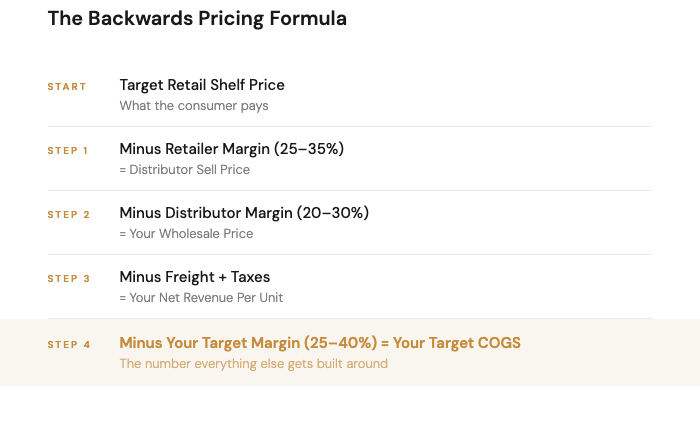
Your target COGS is the number your product development process has to be built around. Not the other way around.
THE NUMBERS IN PRACTICE
Here's how this plays out with a real-world example:
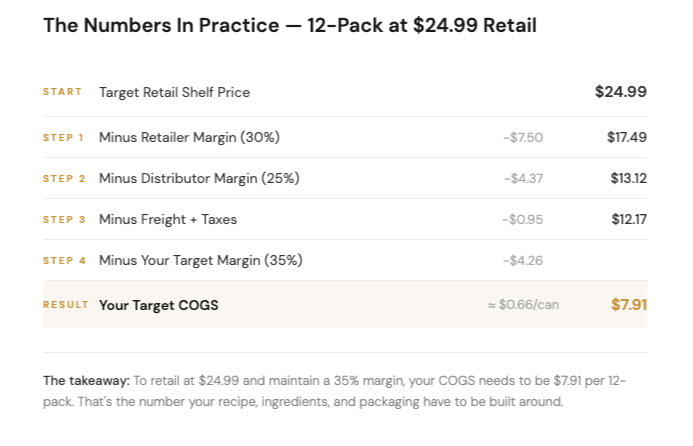
In other words: To sell a 12-pack at $24.99 retail and maintain a 35% margin, your COGS needs to be $7.91 per 12-pack (roughly $0.66 per can). That's the number your recipe, your ingredients, and your packaging have to be built around.
WHAT TO DO WHEN THE MATH DOESN'T WORK
If your backwards math reveals a target COGS that's unrealistic - say your actual COGS is $9.50 but your target is $7.91 - you have work to do. This is where strategy comes in.
You have three variables to work with: COGS, your margin, and retail price. One or more of them has to move.
Can you lower COGS without sacrificing quality? Better supplier pricing, more efficient production, or packaging and ingredient adjustments that reduce cost without compromising the product are all worth exploring before you accept that the numbers don't work.
Can you accept a lower margin temporarily while you build volume and improve your cost structure? Some brands run leaner margins early with a clear path to better economics at scale. This can work if the path is real and the timeline is defined.
Or does your product quality justify a higher retail price? If you're committed to premium ingredients that drive higher COGS, your brand positioning has to support it. Consumers will pay more, but only when the perceived value is obvious and the brand communicates it clearly. This is where pricing strategy and brand positioning intersect.
The goal isn't to force the math to work by slashing margins or overpricing your product. It's to find the balance that lets you build something sustainable.
WHY THIS CHANGES EVERYTHING ABOUT PRODUCT DEVELOPMENT
When you run this formula before you finalize a product, everything about how you build it changes. Ingredient decisions, packaging choices, production volume targets; all of it gets made with a clear COGS ceiling in mind. You stop building products and hoping the math works, and start building products designed to win from day one.
The brands that compete consistently in retail aren't necessarily the ones with the best recipes. They're the ones that understood the economics of their competitive set before they committed a dollar to production.
Your target retail price is not a suggestion. It's a design constraint. Everything else gets built to hit that number.
Start Building a Brand That Wins
Want the complete backwards pricing framework? The Pricing Strategy Playbook walks through the full formula, real-world examples, and how to apply it to your product development process. Available at fivestarbeverage.com/resources.
Not sure where to start? Book a free strategy call and we'll help you figure out where your pricing stands.